

Somali Chapati
- Soomaali
- Sabaayad
- Français
- Chapati Somali
- العربية
- لم يُترجم بعد
بقلم ليلى وعبدالله · ·
لم تُترجم بعد إلى العربية. تُعرض بـالإنجليزية.
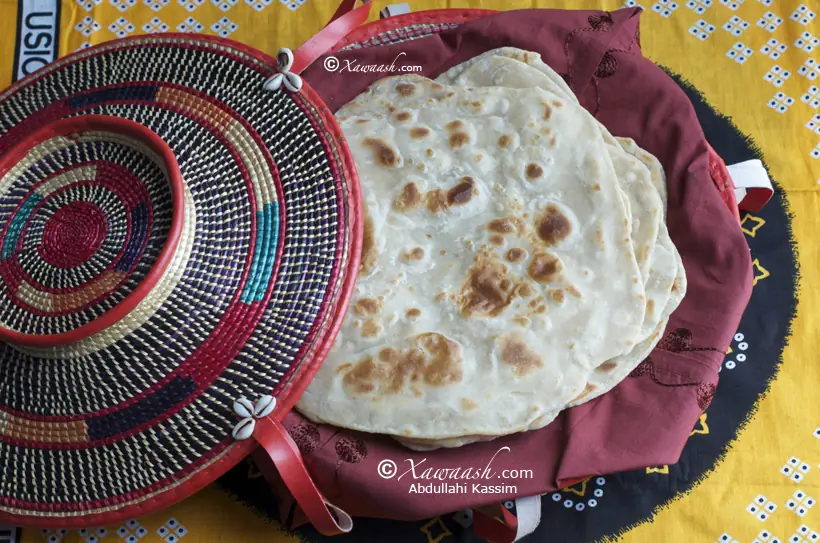
This flatbread is different from the Indian chapati and is more like a paratha. The Somali chapati (sabaayad) is crispy on the outside and flaky and tender inside. It is slightly sweet, and it is cooked to a golden colour with a little oil. This style of chapati is popular in many parts of East Africa and it is usually served with different types of stews.
Unlike Anjero, this is not a bread that is made daily, but is more like a weekly treat. In Somalia, it is usually served for lunch with a goat or lamb stew. It is also served as an afternoon snack with some honey and a cup of tea. Sabaayad is more popular in the northern parts of Somalia, where it is a must-have when inviting people over or for occasions like festive gatherings and weddings.
We had a recipe for sabaayad but we wanted to make a more tender one. We looked for other recipes and we got help from two friends. Maryan Abdi’s version of sabaayad was made from a combination of all-purpose flour and durum atta flour. It also had eggs in it. The result was a tender and flaky sabaayad, but we wanted the first recipe of sabaayad that we were going to post to have ingredients that are readily available to all our viewers. Atta flour is not readily available to some. Eggs are also not added to sabaayad by most Somalis. However, we hope to post Maryan’s recipe at a later date.
Fouwzia Haji Hussein is another friend who gave us a recipe for sabaayad. She used all-purpose flour, milk and water, which is what most Somalis use, but she added baking powder. The result was also a good sabaayad that was tender and flaky.
Our recipe builds on those two recipes with some changes. We wanted the sabaayad to stay tender for a longer period and in order to do that we decided to add some whole wheat flour and to use hot milk. We sifted the whole wheat flour so as not to alter the taste of the traditional Somali sabaayad. We were pleased with the result and we hope that you will also be pleased with it.
شاهد

المقادير
1 cup = 237 mL · 1 Tbsp = 15 mL · 1 tsp = 5 mL. All are level measurements.
طريقة التحضير
اضغط على الخطوة لتعليمها كمنجزة.
Sift the whole wheat flour.
Put all the ingredients, except the milk, in a mixing bowl. Start the mixer and gradually pour in the hot milk. Mix for 5 minutes.
If mixing by hand, pour in the hot milk and mix with a wooden spoon. Knead the dough for at least 15 minutes.
Smear 1 tablespoon of oil on the dough and transfer to a plastic bag. Let the dough rest for 30 to 45 minutes.
Shape the dough into an elongated form and cut into 8 equal pieces. Roll out each piece of dough into a rectangular shape as shown.
Spread 1 tablespoon of oil on the surface of the dough, then fold as shown.
Roll out the chapati dough making it into a thin rectangle. If you prefer, you could make your chapati into a circular shape.
Place the chapati on a preheated skillet set on medium heat. Wait until bubbles start to form, about 1 minute.
Flip the chapati and pour 1 tablespoon of oil underneath it. You can eliminate the oil if you so desire.
Reduce the heat to low. Push down the edges of the chapati to maintain contact with the pan. You can use a towel or a spatula for pushing down the chapati.
Flip again and add another tablespoon of oil underneath the chapati. Flip 4 or 5 times without adding more oil. Cook the chapati for a total of 4 to 5 minutes.
Place the chapati in a covered container to keep them warm and tender. Serve with Chicken Stew (Maraq Digaag) or any other stew that you prefer.
التعليقات
97 تعليقشكرًا! سيظهر تعليقك بعد مراجعته.
حدث خطأ. يُرجى المحاولة مرة أخرى.
a.a,
hello and how are you? recently i am a big fun of cooking and u blog has been my ray of light, as a somali student in the far east (china), i didnt know that my mum’s homemade specials could be at my finger tips whenever i wanted them. now i can make my own everything and suprise my mum with a picture, saying “hooyo look at what i made”.
thanks so much this, God bless you.
We are fine, thank you. We are happy we could help. Thank you very much for the nice comment.
Assalamu alaykum. Thank you so much for sharing this incredible recipe for sabayaad. I wanted to ask, is it necessary to add the baking powder or sabayaad can turn out fine without it? Shukran!
Yes, the baking powder is necessary for this recipe.
Thank you for your time and effort, I have tried making sabaayad multiple times, but the bubble never forms, and I can’t figure out what I am doing wrong.
The measurements have to be precise and you have to use medium heat.
aselem alaikom,
Cela fait un an que je me delecte devant cette recette de pain qui m’a l’air delicieuse ! Barakalahoufikom pour le partage ! En tous cas je vais l’essayer durant ce ramadhan 2014 inshaAllah.
Aselem alaikom
Thank you very much for your comment. Ramadan Kareem.
Assalamu Alaykum Wa Rahmatullaahi Wa Barakaatuh
Jazakaa Allaah kheyr for sharing this recipe. I finally know how to make sabayaad, which felt like it was impossible until it was posted on here!
The thing that attracted me the most, is the gorgeous cover its in. Is it possible to purchase it anywhere?
Wa’alaikum Assalam Warahmatullahi Wabaraktuh.
Thank you very much for your encouraging words. We are happy you like our way of making chapati.
The cover was a gift from a friend.