

Somali Anjero
- Soomaali
- Canjeero
- Français
- Anjero Somali
- العربية
- لم يُترجم بعد
بقلم ليلى وعبدالله · ·
لم تُترجم بعد إلى العربية. تُعرض بـالإنجليزية.
Somalis have their version of Hot cross buns! Hot cross buns! Only it’s not a nursery rhyme, it’s not about buns, and it’s not about something that you give to your daughters or sons. It’s a street cry, it’s about anjero, and you give it to the lion in the house. That lion of course is the husband who enjoys a privileged status in the Somali patriarchal household. The street cry echoes across neighbourhoods in Somali towns and goes like this:
That cry was used by street vendors selling anjero very early in the morning before people went to work and schoolchildren left for school. Most Somalis prepare the anjero themselves, but it needs to be prepared the night before using a starter that was left from the previous morning’s anjero batter. If they use up all the batter, they would borrow some from the neighbours. If for some reason it is not available, then the anjero lady would come to the rescue early in the morning.
Every night, before the cities and towns of Somalia go to sleep, you will hear rhythmic sounds of slapping, the sound of mixing the anjero batter. It is a comforting and reassuring sound that lulls you to sleep, knowing that tomorrow’s meal is being prepared. This rhythmic sound together with the anjero street cry that echoes early in the morning, punctuate the urban soundscape of Somalia.
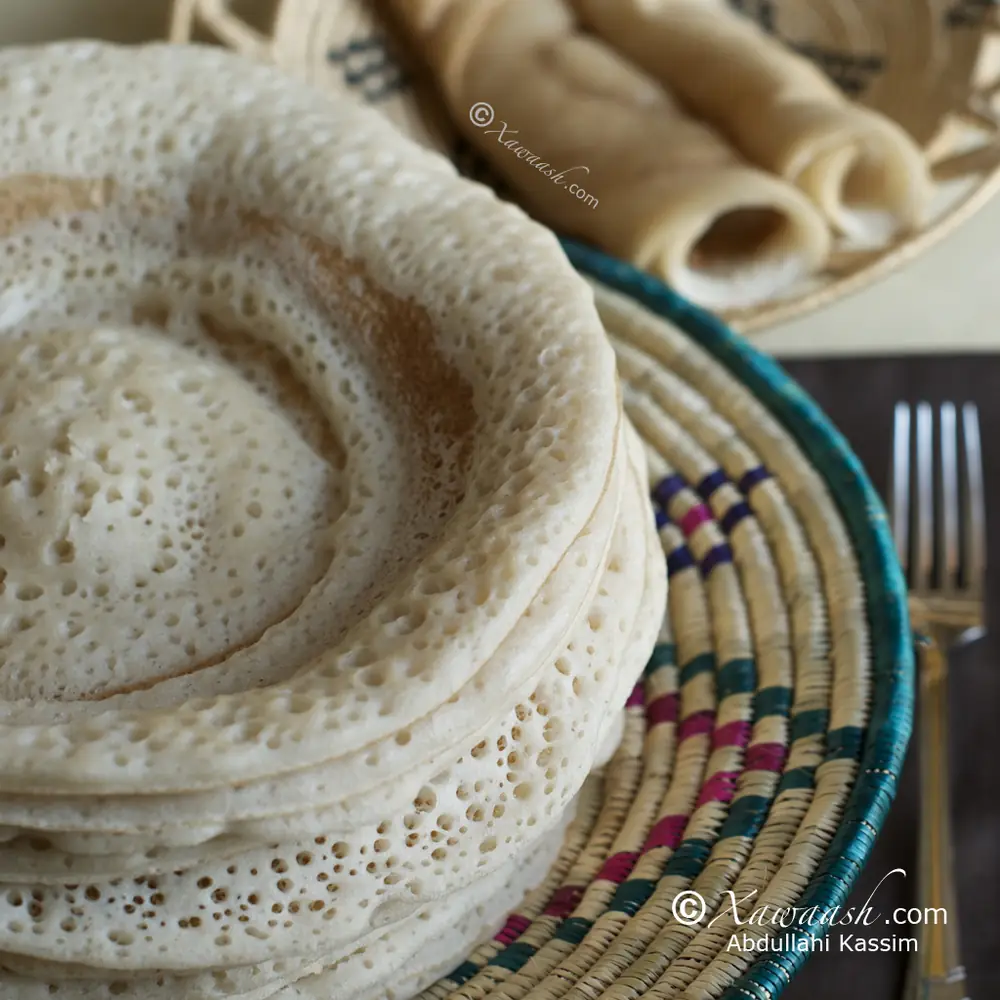
So what exactly is anjero? Most people would know its older sibling, the Ethiopian injera. It is a fermented, crepe-like pan bread that looks like a thin pancake. The Somali anjero has its own character and is different from the Ethiopian injera. It is much less sour, it is smaller in size, and it doesn’t contain teff flour. The traditional Ethiopian injera is usually fermented for a couple of days, whereas the Somali anjero is fermented just overnight.
Anjero is a staple food in Somalia and it’s the most common breakfast food. Everyone would eat an average of three anjeros with a cup of tea. The anjero would be sprinkled with some sugar and drizzled with a little sesame oil or melted ghee. For those who can afford it, the anjero is served with liver and onions, with suqaar (small pieces of beef), or with oodkac (tiny pieces of jerky-style beef). Occasionally anjero is eaten during lunch. It is served with a tomato-based stew or with a goat and vegetable stew.
Anjero was traditionally made of maize, flour, and water. Different types of flour were used; the most common being wheat flour, sorghum flour, and corn flour. The maize was ground finely and then made into a paste. This was then added to the flour and water and was left to ferment overnight. When the anjero was cooked in the morning, some of the fermented batter was left for preparing the next day’s anjero.
شاهد

المقادير
1 cup = 237 mL · 1 Tbsp = 15 mL · 1 tsp = 5 mL. All are level measurements.
Add the starter to the following
طريقة التحضير
اضغط على الخطوة لتعليمها كمنجزة.
Prepare the starter mixture
Combine the sorghum flour, white corn meal, yeast, and lukewarm water. Mix well then let the yeast activate and the mixture soak for one hour.
Prepare the anjero batter
Combine the starter mixture with the self-rising flour, sugar and water. If you mix by hand, add the water in stages to avoid lumps. You can also use a blender, food processor, or handheld electric mixer.
After mixing the batter very well, let it ferment for at least two hours. Fermentation is essential for an authentic anjero taste.
If you prefer a more sour anjero, let the batter ferment some more, even overnight. You can also refrigerate the batter and keep it for two days.
Cooking the anjero
You don’t need a special pan to cook anjero. Any non-stick pan would do. Just make sure that the diameter of the anjero is smaller than that of the pan to facilitate removing the cooked anjero. Every now and then, wipe the pan with a paper towel dipped in a little oil.
Heat a non-stick pan over medium heat. Using a ladle scoop the anjero batter into the pan. The quantity scooped will depend on the size of the pan and the size of the anjero you want to make.
Using a swirling motion, spread the batter over the pan, as if drawing a spiral with the ladle.
Cook the anjero until all the batter dries up. Somalis usually cover the pan when cooking anjero and it reduces the cooking time. However, we didn’t notice any difference in the cooked anjero when we didn’t cover the pan. Moreover, not covering the pan makes it easier to see when the anjero is done.
Recipe B
Combine all the ingredients and mix well, making sure that there are no lumps in the batter. Let the batter ferment for at least two hours. Cook as above.
Recipe C
Combine all the ingredients and mix well, making sure that there are no lumps in the batter. Let the batter ferment for at least two hours. Cook as above.

التعليقات
99 تعليقشكرًا! سيظهر تعليقك بعد مراجعته.
حدث خطأ. يُرجى المحاولة مرة أخرى.
I love your foodblog and your YouTube channel, it’s amazing! In 2013 I was touched by the Somali culture, cuisine and kind people. I am glad I found this website so I can learn more about your cuisine and make more amazing recipes.
Love from the Netherlands :))
Salam wa alaikum,
I tried receipe B and it’s very sticky on the top like mushy. How can I stop that and can I add more corn flour to the same batter?
Really appreciate your response.
Hello and thank you for this wonderful recipe, thank you for making this my kids will be happy today when they come home from school and smell this wonderful bread. Can you please tell me the name of the dish above the stew picture. It’s sliced meat with green specks on top. It’s looks very good I would like to make it but I didn’t know the name of the dish.
Asalaamu Alaykum,
Thank you for this recipe and so many others. I am married to a Somali and it’s helped me make so many of his favourite dishes. Do you know if there is a gluten free replacement for the self-rising flour. Canjeero used to be my husbands favourite but he can no longer have gluten. What would the quantities/ratios of the flours be if there is a replacement?
Jazakallah Khair!
I wanted to know if you have recipe for canjeelo for people who need to avoid gluten. Thank you